These are some of the Roman denarii coins I have.
This isn't a collection with any particular purpose or direction — just odd coins that I have acquired.
| Details |
Nation |
Image |
Antoninus Pius — Denarius (AD 154–155)
Mint: Rome
Obverse:
ANTONINVS AVG PIVS P P TR P XVIII; laureate head right
Reverse:
COS IIII; Annona standing left, holding two corn ears; left hand resting on modius set on prow
Type: Denarius
References:
RIC 239
Historical Note:
Annona was the personification of the grain supply, a critical element for the stability of Rome. Depictions of Annona—often shown with a modius
(a grain measuring vessel) and a prow—served as public assurances that the Emperor was successfully managing the essential food supply for the populace.
This type underscores the benevolence and administrative competence of Antoninus Pius during his long, peaceful reign.
|
Roman Empire

|

|
Antoninus Pius — Denarius (AD 156–157)
Mint: Rome
Obverse:
ANTONINVS AVG PIVS P P IMP II; laureate head right
Reverse:
TR POT XX COS IIII; Annona seated right, holding cornucopia; modius at feet
Type: Denarius
References:
RIC 262
Historical Note:
Building on the themes of imperial benevolence, this seated representation of Annona emphasizes the abundance and stability of the grain supply.
The presence of the modius at her feet, combined with the cornucopia, serves as a visual guarantee of the Emperor’s ongoing commitment to the welfare
of the Roman citizens, reinforcing Antoninus Pius’s reputation as a provident and caring ruler.
|
Roman Empire
|

|
Antoninus Pius — Denarius (AD 145–161)
Mint: Rome
Obverse:
ANTONINVS AVG PIVS P P; laureate head right
Reverse:
COS IIII; clasped hands holding grain ears and caduceus
Type: Denarius
References:
RIC 136
Historical Note:
The motif of clasped hands (dextrarum iunctio) is a traditional symbol of concord (harmony) and loyalty.
When paired with grain ears and a caduceus, it carries a dual message: the promise of peace and harmony between the Emperor and the Senate,
and the assurance of prosperity through the protection of the grain supply. It serves as a quintessential expression of the stability that
characterized the Antonine period.
|
Roman Empire
|

|
Antoninus Pius — Denarius (AD 151–152)
Mint: Rome
Obverse:
ANTONINVS AVG PIVS P P TR P XV; laureate head right
Reverse:
COS IIII; Vesta standing left, holding simpulum and palladium
Type: Denarius
References:
RIC 203
Historical Note:
Vesta, the goddess of the hearth, home, and family, was central to Roman religious life.
By depicting her with the palladium (the sacred image of Athena Pallas, believed to protect Rome) and the simpulum
(a ladle used in religious sacrifices), Antoninus Pius emphasized his role as the protector of Roman religious tradition.
This imagery reinforced his status as a pious guardian of the state’s sacred integrity, matching his cognomen, Pius.
|
Roman Empire
|

|
Faustina Sr. — Denarius (Posthumous, issued under Antoninus Pius AD 141–161)
Mint: Rome
Obverse:
DIVA FAUSTINA; draped bust right
Reverse:
CERES; Ceres standing left, holding grain ears and long torch
Type: Denarius
References:
RIC 378
Historical Note:
Following the death of his wife, Faustina the Elder, in 140 or 141 CE, Antoninus Pius launched an extensive commemorative coinage program to
honor her as "Diva" (divine). The association with Ceres—the goddess of agriculture and maternal love—was particularly fitting, as it linked
the memory of the late Empress to the prosperity and fertility of the Roman state, further cementing the prestige of the Antonine dynasty.
|
Roman Empire

|

|
Faustina Jr. — Denarius (issued under Antoninus Pius, AD 161–164)
Mint: Rome
Obverse:
FAVSTINA AVGVSTA; diademed and draped bust right
Reverse:
FECVNDITAS; Fecunditas standing right, holding sceptre and infant
Type: Denarius
References:
RIC 677
Historical Note:
The term Fecunditas personified fertility and was a vital propaganda tool for the Empress. Given that the survival and continuation of the
Nerva-Antonine dynasty were paramount, Faustina the Younger’s prolific childbearing was essential for securing the imperial succession.
By featuring this type, the state celebrated the Empress as the guarantor of the future, linking her maternal role directly to the stability
and longevity of the Roman Empire.
|
Roman Empire

|

|
| Details |
Nation |
Image |
Septimius Severus — Denarius (AD 194)
Mint: Rome
Obverse:
SEPT SEV PERT AVG IMP III; laureate head right
Reverse:
LIBERO PATRI; Bacchus standing left, holding oenochoe over panther reaching up; thyrsus in left hand
Type: Denarius
References:
RIC 32
Historical Note:
*Libero Patri* refers to the god Bacchus (Dionysus), a deity particularly favored by Septimius Severus, who was born in Leptis Magna—a city
where Bacchus was highly revered. By incorporating this type into his coinage, Severus was not only celebrating a god of wine and prosperity
but also making a subtle reference to his North African roots, effectively bridging his provincial origins with the established Roman pantheon
to reinforce his authority as the new Emperor.
|
Roman Empire

|

|
Septimius Severus — Denarius (AD 201–202)
Mint: Rome
Obverse:
L SEPT SEV AVG IMP XI PART MAX; laureate head right
Reverse:
PROVID AVGG; Providentia standing left, holding wand over globe and sceptre
Type: Denarius
References:
RIC 139
Historical Note:
*Providentia*—the personification of divine foresight or imperial providence—was a critical theme for Septimius Severus, especially after his
victory over the Parthians ("PART MAX" on the obverse). By depicting Providentia with a globe, the coin highlights the Emperor’s role in planning
for the stability and future security of the entire Roman world, reassuring both the army and the citizens of a well-guided imperial administration.
|
Roman Empire

|

|
Septimius Severus — Denarius (AD 200)
Mint: Rome
Obverse:
SEVERVS AVG PART MAX; laureate head right
Reverse:
P M TR P VIII COS II P P; Victory flying left, holding wreath over shield on base
Type: Denarius
References:
RIC 150
Historical Note:
The image of a flying Victory holding a wreath over a trophy or shield is a classic motif celebrating military triumph.
For Septimius Severus, this coinage served as persistent public validation of his Parthian campaigns. By emphasizing "Victory," Severus
underscored his legitimacy as a martial leader, ensuring that the Roman populace and the military alike associated his reign with successful
conquest and the expansion of imperial power.
|
Roman Empire
|

|
Septimius Severus — Denarius (AD 203)
Mint: Rome
Obverse:
SEVERVS PIVS AVG; laureate head right
Reverse:
P M TR P XI COS III P P; Fortuna seated left with rudder and cornucopia; wheel beneath seat
Type: Denarius
References:
RIC 189b
Historical Note:
Fortuna, the goddess of luck and chance, was a central figure in Roman imperial ideology. Her presence on this coinage, seated with a rudder
(governing the course of events) and a cornucopia (abundance), suggests that Septimius Severus sought to attribute his continued reign and the
prosperity of the state to divine favor. The inclusion of the wheel beneath her seat—a standard attribute of Fortuna—reinforces the cyclical and
sometimes unpredictable nature of power, which the Emperor aimed to stabilize through his leadership.
|
Roman Empire
|

|
Septimius Severus — Denarius (AD 203)
Mint: Rome
Obverse:
SEVERVS PIVS AVG; laureate head right
Reverse:
P M TR P XI COS III P P; Genius standing left, holding patera and double cornucopia
Type: Denarius, Silver
References:
RIC 219
Historical Note:
The Genius was a fundamental concept in Roman belief, representing the divine protective spirit of an individual, a family, or an
institution—in this case, the spirit of the Roman people or the Emperor himself. By holding a patera (for sacrifice) and a double
cornucopia (symbolizing overflowing prosperity), the figure of the Genius emphasizes that the welfare and growth of the Empire are inextricably
linked to religious observance and the Emperor’s role as the primary intermediary with the gods.
|
Roman Empire
|

|
Septimius Severus — Denarius (AD 209)
Mint: Rome
Obverse:
SEVERVS PIVS AVG; laureate head right
Reverse:
P M TR P XVII COS III P P; Neptune standing left, holding trident, foot on globe
Type: Denarius
References:
RIC 228
Historical Note:
The depiction of Neptune, god of the sea, holding a trident with his foot resting upon a globe, is a bold assertion of imperial command over
both the seas and the world at large. For Septimius Severus, whose maritime security was vital for the grain supply and the movement of his legions,
Neptune served as a divine guarantor of imperial control across the Mediterranean. This imagery underscores the Emperor's reach and his role as the
master of a vast, interconnected Roman domain.
|
Roman Empire
|

|
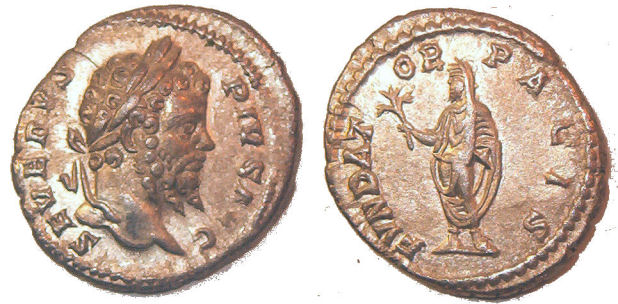
Septimius Severus — Denarius (AD 210)
Mint: Rome
Obverse:
SEVERVS PIVS AVG; laureate head right
Reverse:
FVNDATOR PACIS; Septimius Severus, togate and veiled, standing left holding olive branch
Type: Denarius, Silver
References:
RIC 265
Historical Note:
The title Fundator Pacis ("Founder of Peace") was a powerful piece of political propaganda. After the chaotic civil wars that followed
the death of Commodus, Septimius Severus sought to frame himself not just as a military victor, but as the restorer of order and stability.
By depicting himself veiled and togate—the attire of a religious official—he emphasized his role as a pious leader committed to peace through
divine favor and orderly governance, seeking to legitimize his dynasty in the eyes of the Roman Senate and the public.
|
Roman Empire
|
|
Septimius Severus — Denarius (AD 194–195)
Mint: Emesa
Obverse:
IMP CAE L SEP SEV PERT AVG COS II; laureate head right
Reverse:
LIBER AVG; Liberalitas seated left, holding coin counter and cornucopia
Type: Denarius
References:
RIC 401
Historical Note:
The Emesa mint played a crucial role during the early part of Septimius Severus’s reign, particularly as he consolidated power in the East
following the defeat of his rival, Pescennius Niger. The Liberalitas type issued here serves as a clear declaration of the Emperor's
authority and his commitment to the traditional imperial duty of providing for the Roman people, even as he operated from the eastern frontiers
to secure his new administration.
|
Roman Empire
|

|
Julia Domna — Denarius (issued under Caracalla, AD 211–217)
Mint: Rome
Obverse:
IVLIA PIA FELIX AVG; draped bust right
Reverse:
MATRI DEVM; Cybele standing left, leaning on column, holding drum and sceptre; lion at feet
Type: Denarius
References:
RIC 382
Historical Note:
The reverse legend MATRI DEVM ("Mother of the Gods") refers to Cybele, an ancient Phrygian mother goddess whose cult had been deeply
integrated into Roman religious life for centuries. Julia Domna frequently aligned herself with powerful female deities to enhance her own image as a
maternal and authoritative figure within the imperial household. By linking herself with the "Mother of the Gods," she emphasized her status as the
mother of the future emperors and her pivotal role as the divine-like guardian of the Severan dynasty.
|
Roman Empire

|

|
Julia Domna — Denarius (issued under Caracalla, AD 211–217)
Mint: Rome
Obverse:
IVLIA PIA FELIX; draped bust right
Reverse:
VENVS GENETRIX; Venus seated left, extending right hand and holding sceptre
Type: Denarius
References:
RIC 388c
Historical Note:
Venus Genetrix (Venus the Mother) was a title deeply rooted in the Roman imperial tradition, famously traced back to the Julian family.
By adopting this imagery, Julia Domna was not only emphasizing her own role as the mother of the imperial line but also positioning herself as the
spiritual successor to the noble virtues of the past. This reverse type served to broadcast her dynastic legitimacy and her foundational importance
to the stability of the Severan house.
|
Roman Empire
|

|
Julia Domna — Denarius (issued under Septiminus Severus, AD 193–196)
Mint: Rome
Obverse:
IVLIA AVGVSTA; draped bust right
Reverse:
CERERI FRVGIF; Ceres seated left, holding corn ears and torch
Type: Denarius
References:
RIC 546
Historical Note:
The legend CERERI FRVGIF ("To Ceres, bringer of fruit") associates Julia Domna with Ceres, the goddess of agriculture and maternal love.
By depicting the goddess with corn ears and a torch, the coin emphasizes the theme of imperial bounty and fertility.
This was a common way for Roman empresses to signify their role as providers of prosperity and to reassure the public of the state’s food security—a
vital concern for any emperor and his consort.
|
Roman Empire
|

|
Julia Domna — Denarius (issued under Septiminus Severus, AD 193–196)
Mint: Rome
Obverse:
IVLIA AVGVSTA; draped bust right
Reverse:
FELICITAS; Felicitas standing, head left, holding short caduceus and long sceptre
Type: Denarius
References:
RIC 551
Historical Note:
Felicitas represents the personification of good fortune and prosperity.
By featuring this deity, the coinage projects an image of a thriving and lucky Empire under the watchful eye of the imperial family.
For Julia Domna, associating herself with Felicitas served to reinforce her position as a central pillar of the Severan dynasty, suggesting
that her presence and favor were essential to the ongoing success and happiness of the Roman state.
|
Roman Empire
|

|
Julia Domna — Denarius (issued under Septiminus Severus, AD 193–196)
Mint: Rome
Obverse:
IVLIA AVGVSTA; draped bust right
Reverse:
HILARITAS; Hilaritas standing left, holding long palm and sceptre
Type: Denarius
References:
RIC 555
Historical Note:
Hilaritas was the personification of joy, rejoicing, and cheerfulness, often associated with public festivals and celebrations of
imperial events. In the context of Julia Domna’s coinage, this reverse type aimed to project a mood of optimism and festive spirit across the Empire.
By linking herself with the personification of joy, the Empress contributed to the narrative of a peaceful and flourishing reign, projecting the image
of a contented population enjoying the prosperity brought about by the Severan dynasty.
|
Roman Empire
|

|
Julia Domna — Denarius (issued under Septiminus Severus, AD 193–196)
Mint: Rome
Obverse:
IVLIA AVGVSTA; draped bust right
Reverse:
SAECVLI FELICITAS; Isis standing right, wearing polos, left foot on prow, holding Horus; rudder behind
Type: Denarius
References:
RIC 577
Historical Note:
The reverse legend SAECVLI FELICITAS ("Happiness of the Age") paired with the depiction of the Egyptian goddess Isis nursing the infant
Horus is a powerful dynastic statement. Isis, often equated with the ideals of universal motherhood and protection, served as an ideal counterpart
for Julia Domna. By invoking this imagery, the Empress subtly emphasized her own role as the mother of the future emperors, framing the Severan era
as a new, golden age of prosperity and divine legitimacy that bridged the diverse cultures of the Roman Empire.
|
Roman Empire
|

|
Julia Domna — Denarius (issued under Septiminus Severus, AD 196–202)
Mint: Rome
Obverse:
IVLIA AVGVSTA; draped bust right
Reverse:
IVNO REGINA; Juno standing left, veiled, holding patera and sceptre; peacock at left
Type: Denarius
References:
RIC 640
Historical Note:
IVNO REGINA ("Juno the Queen") is one of the most significant titles for a Roman empress. As the consort of Jupiter,
Juno represented the highest level of female divinity, marriage, and childbirth. By adopting this imagery, Julia Domna effectively equated her
status as the Emperor's wife with the celestial authority of Juno. The presence of the peacock—a symbol of Juno’s majesty—further solidifies this
association, presenting the Empress as the divine queen who presides over the Roman world alongside her husband.
|
Roman Empire
|

|
Julia Domna — Denarius (issued under Septiminus Severus, AD 196–202)
Mint: Rome
Obverse:
IVLIA AVGVSTA; draped bust right
Reverse:
PIETAS PVBLICA; Pietas standing front, head left, raising hands in prayer over lighted altar
Type: Denarius
References:
RIC 643
Historical Note:
The term PIETAS PVBLICA ("Public Piety") highlights the essential Roman virtue of dutiful respect toward the gods.
By showing the personification of Pietas in an act of sacrifice at a lighted altar, this coin reinforces the idea that the stability and favor of
the state were maintained through the religious devotion of the imperial family. Julia Domna, in particular, was frequently portrayed as the
embodiment of this piety, bridging the gap between the earthly realm and the divine to ensure the continued protection of the Empire.
|
Roman Empire
|

|
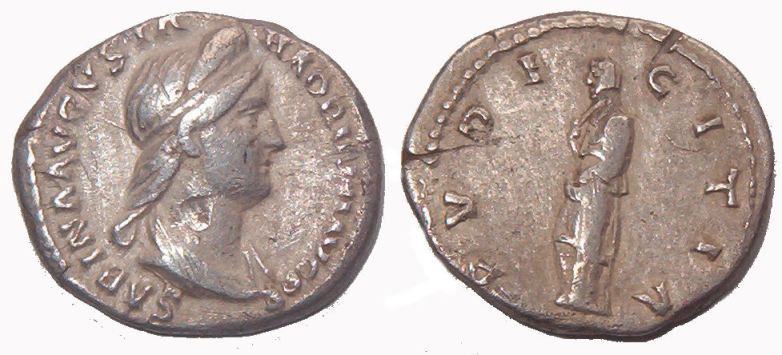
Julia Maesa — Denarius (issued under Elagabalus, AD 218–220)
Mint: Rome
Obverse:
IVLIA MAESA AVG; draped bust right
Reverse:
PVDICITIA; Pudicitia seated left, raising veil and holding sceptre
Type: Denarius
References:
RIC 268 (RIC668 in older versions)
Historical Note:
Pudicitia, the personification of modesty, sexual virtue, and purity, was a vital attribute for any Roman empress or noblewoman.
For Julia Maesa, who was instrumental in securing and maintaining the Severan dynasty, the emphasis on this virtue served to align her image
with the traditional moral expectations of the Roman elite. By depicting the figure adjusting her veil—the classic gesture of modesty—the coin
projects a message of respectability and traditional dignity, essential traits for the matriarch of the imperial house.
|
Roman Empire

|

|
Julia Mamaea — Denarius (issued under Severus Alexander, AD 222–235)
Mint: Rome
Obverse:
IVLIA MAMAEA AVG; diademed and draped bust right
Reverse:
FELICITAS PVBLICA; Felicitas standing, head left, holding caduceus and resting arm on column
Type: Denarius
References:
RIC 335
Historical Note:
FELICITAS PVBLICA ("Public Happiness") was a frequent theme in the coinage of Julia Mamaea, who acted as the powerful and influential
regent for her son, Alexander Severus. The imagery of Felicitas resting on a column conveys stability and the support provided by the Empress to the
Roman state. By using this legend, Mamaea aimed to broadcast that her administration and the guidance she provided to her son were the direct sources
of the Empire’s ongoing peace, prosperity, and security.
|
Roman Empire

|

|
Julia Mamaea — Denarius (AD 222–235) issued under Severus Alexander
Mint: Rome
Obverse:
IVLIA MAMAEA AVG; diademed and draped bust right
Reverse:
VENVS VICTRIX; Venus standing front, head left, holding helmet and sceptre; shield at feet
Type: Denarius
References:
RIC 338
Historical Note:
VENVS VICTRIX ("Venus Victorious") is an intriguing reverse type that combines the traditional goddess of love and beauty with the
attributes of martial victory, specifically the helmet and shield. By adopting this imagery, Julia Mamaea projected a powerful and unconventional
persona, suggesting that she possessed both the gentle grace of a mother and the strength to protect the imperial household. This coin reinforces
the idea of the Empress as a multifaceted leader capable of navigating both domestic and political spheres of influence.
|
Roman Empire
|

|
| Details |
Nation |
Image |
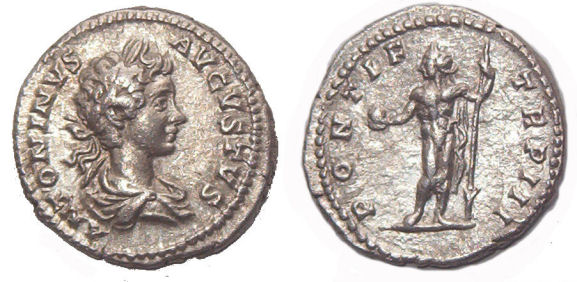
Caracalla — Denarius (AD 200)
Mint: Rome
Obverse:
ANTONINVS PIVS AVG; laureate, draped and cuirassed bust right
Reverse:
PONTIF TR P III; Sol standing front, radiate, naked, holding orb and spear
Type: Denarius
References:
RIC 30a
Historical Note:
The depiction of Sol (the Sun god) on this denarius is significant as the Severan dynasty placed increasing emphasis on solar imagery.
Caracalla’s association with Sol reflects the imperial family's growing interest in Eastern solar cults, which promised stability and divine favor.
By featuring the god of the sun on his coinage, Caracalla was beginning to establish the powerful link between the person of the Emperor and the
radiant, all-seeing authority of the Sun, a theme that would become even more central to imperial propaganda later in his reign.
|
Roman Empire

|
|
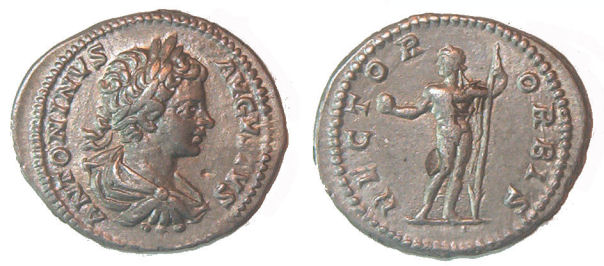
Caracalla — Denarius (AD 201–206)
Mint: Rome
Obverse:
ANTONINVS AVGSTVS; laureate, draped and cuirassed bust right
Reverse:
RECTOR ORBIS; Sol standing front, head left, holding globe and reversed spear
Type: Denarius
References:
RIC 39b
Historical Note:
The legend RECTOR ORBIS ("Governor of the World") is a powerful declaration of imperial authority.
When paired with the imagery of Sol, it emphasizes the Emperor’s role as the earthly counterpart to the sun god, governing the world with divine sanction.
By adopting this title, Caracalla was positioning himself not merely as a regional ruler, but as a central, cosmic figure—a key element of the
Severan dynasty's effort to elevate the imperial office above traditional Republican constraints and link it directly to the heavens.
|
Roman Empire
|
|
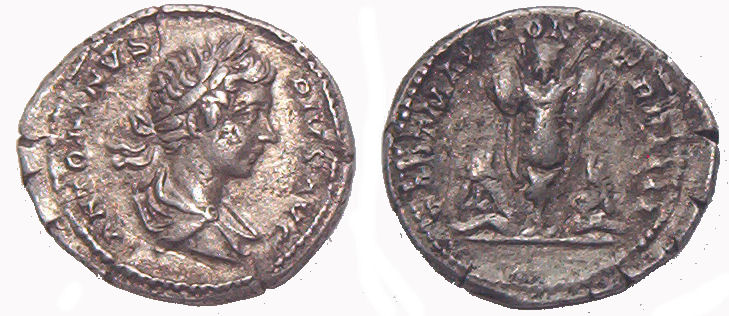
Caracalla — Denarius (AD 201)
Mint: Rome
Obverse:
ANTONINVS AVGSTVS; laureate, draped and cuirassed bust right
Reverse:
PART MAX PONT TR P IIII; two Persians bound and seated back‑to‑back at base of trophy
Type: Denarius
References:
RIC 54b
Historical Note:
The legend PART MAX refers to Parthicus Maximus, a title commemorating the victories of the Severan dynasty against the Parthian Empire.
By depicting two bound captives at the base of a trophy of arms, this coin serves as a potent piece of military propaganda.
It emphasizes the dominance of the Roman Empire over its greatest Eastern rival, reinforcing the image of the young Caracalla as a powerful defender
of the state and highlighting the martial achievements that helped secure the legitimacy of the dynasty.
|
Roman Empire
|
|
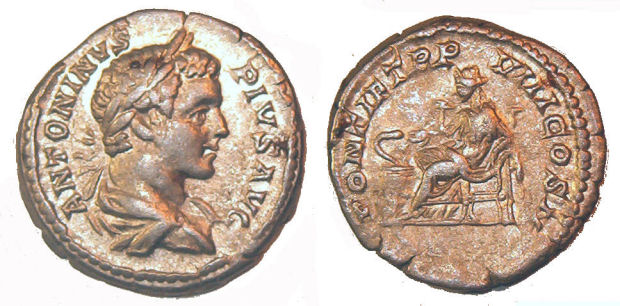
Caracalla — Denarius (AD 205)
Mint: Rome
Obverse:
ANTONINVS PIVS AVG; laureate, draped bust right
Reverse:
PONTIF TR P VIII COS II; Salus, draped, seated left, feeding out of patera in right hand snake coiled round altar and resting left arm on side of chair.
Type: Denarius
References:
RIC 82
Historical Note:
The inclusion of Mars—The reverse depicts Salus, the goddess of health, safety, and public welfare, feeding the sacred serpent from a patera.
This image conveyed far more than personal well-being; it symbolised the health of the emperor as essential to the health of the Roman state itself.
Roman political thought regarded the security and prosperity of the Empire as inseparable from the welfare of its ruler.
|
Roman Empire
|
|
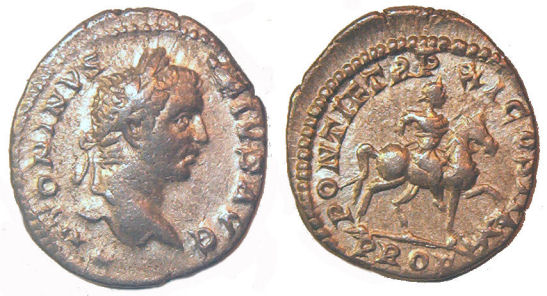
Caracalla — Denarius (AD 207–208)
Mint: Rome
Obverse:
ANTONINVS PIVS AVG; laureate head right
Reverse:
PONTIF TR P XI COS III / PROF in ex.; emperor on horseback right, holding spear; enemy kneeling before
Type: Denarius
References:
RIC 108
Historical Note:
The term PROFECTIO refers to the formal departure of an emperor for a military campaign. In 208 CE, this type was struck to mark the
departure of Septimius Severus and his sons, Caracalla and Geta, for the British campaigns. By depicting the Emperor on horseback confronting a
kneeling enemy, the reverse serves as an evocative piece of imperial propaganda, signaling the determination and martial readiness of the
Severan house as they set out to secure and expand the reach of the Roman Empire in the North.
|
Roman Empire
|
|
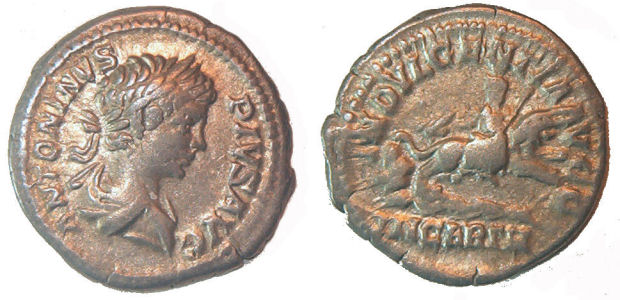
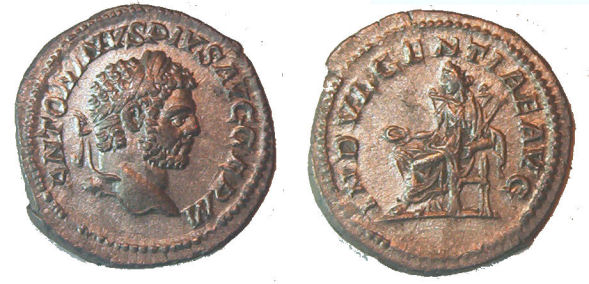
Caracalla — Denarius (AD 206–210)
Mint: Rome
Obverse:
ANTONINVS PIVS AVG; laureate and draped bust right
Reverse:
INDVLGENTIA AVGG IN CARTH; Dea Caelestis riding lion right, holding thunderbolt and sceptre
Type: Denarius
References:
RIC 130a
Historical Note:
The reverse legend INDVLGENTIA AVGG IN CARTH ("The indulgence of the Augusti in Carthage") refers to the special privileges or favors
granted to Carthage by the Severan emperors. Dea Caelestis, the Romanized version of the Punic goddess Tanit, is depicted riding a lion,
symbolizing her divine protection and power. This coin is a example of the Severan family’s efforts to honor their ancestral
North African heritage and promote the prosperity of Carthage within the wider context of the Roman Empire.
|
Roman Empire
|
|
Caracalla — Denarius (AD 210)
Mint: Rome
Obverse:
ANTONINVS PIVS AVG; laureate and draped bust right
Reverse:
VIRTVS AVGG; Virtus standing left, holding Victory and sceptre
Type: Denarius
References:
RIC 149
Historical Note:
The legend VIRTVS AVGG ("The Valor of the Emperors") celebrates the shared military prowess of the Severan co-rulers.
Virtus, the Roman personification of martial courage, is depicted holding a small figure of Victory, symbolizing that military virtue directly leads
to triumph. For the young Caracalla, this imagery was crucial propaganda; it reinforced his image as a capable soldier-emperor and inextricably
linked the stability of the Roman world to the martial strength and unity of the Severan dynasty.
|
Roman Empire
|

|
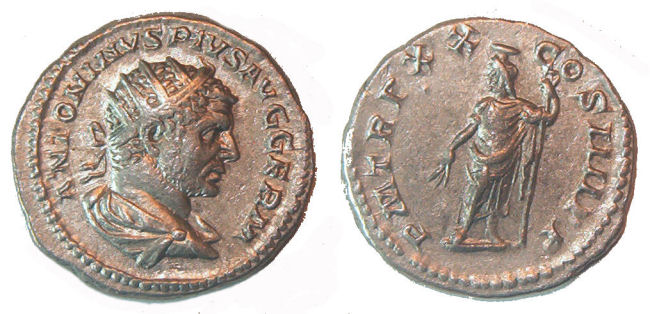
Caracalla — Antoninianus (AD 213-217)
Mint: Rome
Obverse:
ANTONINVS PIVS AVG GERM; radiate, draped bust right
Reverse:
P M TR P XX COS IIII P P; Serapis standing left, wearing polos, holding corn ears and sceptre
Type: Antoninianus
References:
RIC 289d
Historical Note:
The introduction of the Antoninianus (a double denarius) is closely associated with Caracalla's reign.
This specific reverse type, depicting the syncretic Egyptian deity Serapis, reflects Caracalla’s deep personal devotion to the god.
Serapis, who combined elements of Osiris and Apis with Greek influences, was viewed as a healer and a protector.
Caracalla’s emphasis on this deity underscored the cosmopolitan nature of his rule and his desire to seek divine favor and protection during the final,
tumultuous year of his life.
|
Roman Empire
|
|
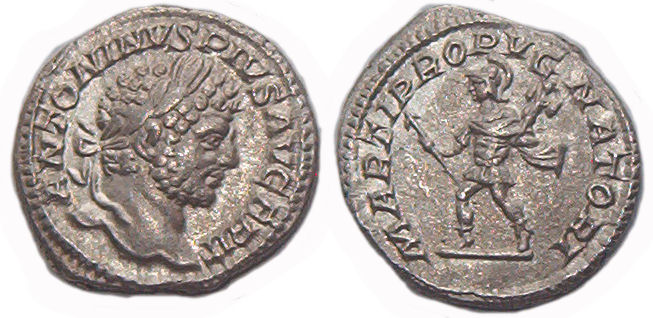
Caracalla — Denarius (AD 213-217)
Mint: Rome
Obverse:
ANTONINVS PIVS AVG GERM; laureate head right
Reverse:
MARTI PROPVGNATORI; Mars walking left, holding spear and trophy
Type: Denarius
References:
RIC 223
Historical Note:
The legend MARTI PROPVGNATORI ("To Mars the Defender/Champion") portrays the god of war not just as a combatant, but as an active
protector of the Emperor and the Roman state. By this stage in his reign, Caracalla was increasingly emphasizing his martial identity,
especially with the addition of the title GERM (Germanicus), earned through his campaigns. The depiction of Mars carrying a spear and a
trophy serves as a clear message of aggressive military readiness and successful defense, projecting Caracalla as an invincible warrior-ruler.
|
Roman Empire
|
|
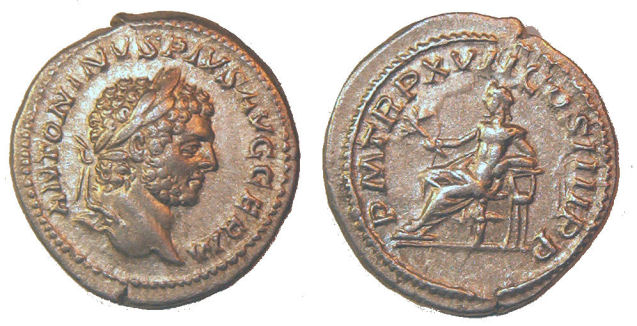
Caracalla — Denarius (AD 214-217)
Mint: Rome
Obverse:
ANTONINVS PIVS AVG GERM; laureate head right
Reverse:
P M TR P XVII COS IIII P P; Apollo seated left, holding branch and leaning on lyre set on tripod
Type: Denarius
References:
RIC 238a
Historical Note:
During his later years, Caracalla frequently sought to associate himself with Apollo, the god of music, prophecy, and healing.
By depicting Apollo seated with his lyre and tripod, this coin reflects the Emperor's intense interest in identifying with divine qualities
of wisdom and poetic inspiration. This choice of reverse also mirrors his fascination with the East and his attempts to emulate heroic figures
like Alexander the Great, who were often linked to Apollonian imagery. It serves as a stark contrast to the martial themes common in his earlier coinage.
|
Roman Empire
|
|
Caracalla — Denarius (AD 214-217)
Mint: Rome
Obverse:
ANTONINVS PIVS AVG GERM; laureate head right
Reverse:
P M TR P XVII COS IIII P P; Jupiter standing left, holding thunderbolt and sceptre; eagle at foot left
Type: Denarius
References:
RIC 240
Historical Note:
The depiction of Jupiter, the king of the gods, on this denarius serves as a powerful validation of imperial authority.
By featuring the supreme deity with his traditional attributes—the thunderbolt, sceptre, and the sacred eagle—the coinage reinforces
the concept that the Emperor’s rule was divinely sanctioned by the highest power in the Roman pantheon. In 214 CE, as Caracalla traveled
extensively through the provinces, this imagery projected stability and divine protection over his reign, aligning the Emperor with the
absolute authority and cosmic order represented by Jupiter.
|
Roman Empire
|

|
Caracalla — Denarius (AD 214-217)
Mint: Rome
Obverse:
ANTONINVS PIVS AVG GERM; laureate head right
Reverse:
P M TR P XVIII COS IIII P P; Serapis standing left, wearing polos, raising right hand and holding sceptre
Type: Denarius
References:
RIC 244
Historical Note:
By 214 CE, Caracalla's devotion to the Egyptian god Serapis had become a hallmark of his later coinage.
Serapis was a complex deity associated with the underworld, healing, and abundance, and his appearance on official imperial currency signaled
a deliberate shift toward more diverse, Eastern-influenced religious practice. The gesture of the god raising his hand while holding the sceptre
suggests an act of divine blessing or command, reinforcing the idea that the Emperor's authority was not only traditional and Roman but also enriched
by universal, divine favor.
|
Roman Empire
|

|
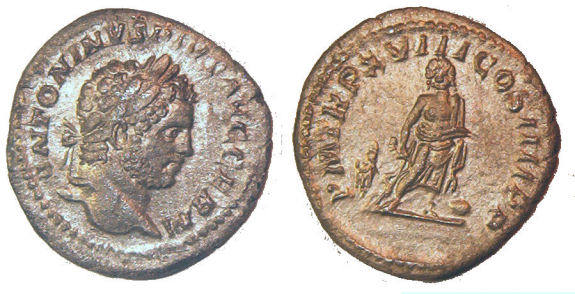
Caracalla — Denarius (AD 214-217)
Mint: Rome
Obverse:
ANTONINVS PIVS AVG GERM; laureate head right
Reverse:
P M TR P XVIII COS IIII P P; Asclepius standing front, leaning on serpent‑staff; globe right; Telesphorus left
Type: Denarius
References:
RIC 253
Historical Note:
Asclepius was the Greco-Roman god of medicine and healing. His appearance on this denarius, accompanied by the small, hooded figure of
his son, Telesphorus (a spirit of recovery), points to Caracalla’s frequent preoccupation with his own health and his reliance on divine
medicine. During this period, the Emperor visited various temples of healing across the empire, and this coin reflects his personal devotion to the
healing arts—a theme that served as a subtle contrast to the more aggressive, martial imagery found throughout the rest of his coinage.
|
Roman Empire
|
|
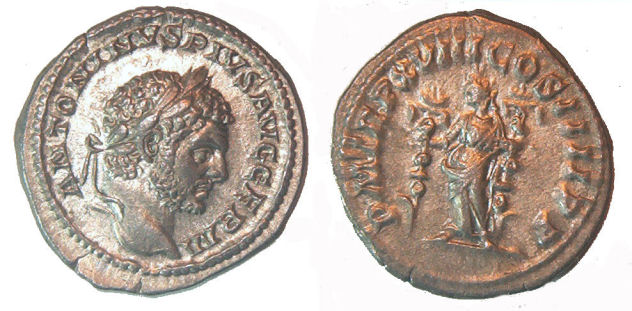
Caracalla — Denarius (AD 215-217)
Mint: Rome
Obverse:
ANTONINVS PIVS AVG GERM; laureate head right
Reverse:
P M TR P XVIII COS IIII P P; Fides standing left between two standards
Type: Denarius
References:
RIC 267
Historical Note:
Fides, the personification of trust, loyalty, and fidelity, was a crucial concept for any Roman emperor, particularly one like
Caracalla who relied heavily on the support of the legions. By depicting Fides between two military standards, this coin directly appeals
to the loyalty of the army. It serves as a visual pledge of the bond between the Emperor and his troops, reassuring the soldiers of his reliability
and stressing the importance of the mutual commitment that maintained the stability of the Severan regime.
|
Roman Empire
|
|
Caracalla — Denarius (AD 215-217)
Mint: Rome
Obverse:
ANTONINVS PIVS AVG GERM; laureate head right
Reverse:
P M TR P XVIII COS IIII P P; Pax standing half‑left, holding branch and sceptre
Type: Denarius
References:
RIC 268
Historical Note:
Pax, the Roman goddess of peace, was a staple of imperial coinage, intended to assure the populace of the stability and tranquility
provided by the Emperor. Even during times of active military campaigns, the depiction of Pax with her traditional attributes—the olive branch
and sceptre—served as an essential propaganda tool, framing the Emperor's actions as a necessary means to secure lasting peace for the Roman
world. It is a recurring symbol that underscores the state's official desire to appear as a guarantor of order and prosperity.
|
Roman Empire
|

|
Caracalla — Denarius (AD 215-217)
Mint: Rome
Obverse:
ANTONINVS PIVS AVG GERM; laureate head right
Reverse:
P M TR P XVIII COS IIII P P; Pax standing half‑left, holding branch and sceptre
Type: Denarius
References:
RIC 268
Historical Note:
Having multiple examples of the same type, such as this Pax denarius, highlights the immense volume of coinage produced under
Caracalla to pay the military and facilitate trade across the Empire. The consistent use of the Pax motif across various issues demonstrates
the importance the administration placed on projecting an image of stability, even amidst the internal political tensions and external military
pressures that characterized the later years of his reign.
|
Roman Empire
|

|
Caracalla — Denarius (AD 215-217)
Mint: Rome
Obverse:
ANTONINVS PIVS AVG GERM; laureate head right
Reverse:
P M TR P XVIIII COS IIII P P; Jupiter enthroned left, holding Victory and sceptre; eagle at foot left
Type: Denarius
References:
RIC 277c
Historical Note:
In this striking depiction, Jupiter is shown enthroned and holding a figure of Victory, a powerful symbolic combination.
By 216 CE, as Caracalla’s reign neared its end, the emphasis on Jupiter as the bringer of victory served to elevate the Emperor’s own status,
equating his rule with the supreme, immovable authority of the king of the gods. The inclusion of the eagle—Jupiter's sacred bird—further cements
the message of divine legitimacy and supreme power, underscoring the Severan claim to absolute, heaven-ordained sovereignty.
|
Roman Empire
|

|
Caracalla — Denarius (AD 216-217)
Mint: Rome
Obverse:
ANTONINVS PIVS AVG GERM; laureate head right
Reverse:
INDVLGENTIAE AVG; Indulgentia seated left, holding patera and sceptre
Type: Denarius
References:
RIC 300
Historical Note:
The personification of Indulgentia—meaning clemency, favor, or imperial grace—was a common reverse type used to project an image of a
benevolent ruler. By highlighting his willingness to grant pardons or provide relief, Caracalla utilized this imagery to soften his often harsh
public persona, particularly during the military-focused campaigns of his later years. The depiction of Indulgentia holding a patera and sceptre
underscores the sacred nature of this imperial grace, presenting it as a divine quality bestowed upon the people by the Emperor himself.
|
Roman Empire
|
|
Caracalla — Denarius (AD 214-2174
Mint: Rome
Obverse:
ANTONINVS PIVS AVG GERM; laureate head right
Reverse:
P M TR P XVII COS IIII P P; Apollo, nude to waist, seated left, holding branch in right hand and resting left hand on lyre set on tripod.
Type: Denarius
References:
RIC 238a
Historical Note:
This issue from 214 CE features Apollo, the god of music, healing, and prophecy.
Caracalla’s frequent use of Apollonian imagery during his later years reflects his deep interest in identifying with divine wisdom and Hellenistic culture.
The inclusion of the lyre and the tripod reinforces the god’s prophetic and artistic nature, serving as a subtle, sophisticated contrast to the more
overtly militaristic reverse types found elsewhere in Caracalla’s coinage.
|
Roman Empire
|
|
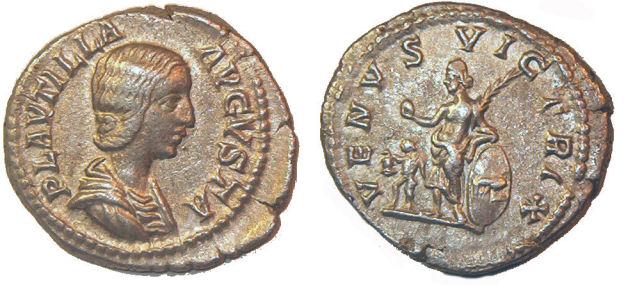
Plautilla — Denarius (issued under Caracalla, AD 202–205)
Mint: Rome
Obverse:
PLAVTILLA AVGVSTA; draped bust right
Reverse:
VENVS VICTRIX; Venus standing left, holding apple and palm, leaning on shield; Cupid at feet
Type: Denarius
References:
RIC 369
Historical Note:
The VENVS VICTRIX ("Venus the Victorious") motif was a frequent choice for imperial women, symbolizing feminine beauty and divine favor.
For Plautilla, the wife of Caracalla, this imagery was intended to project an image of imperial legitimacy and grace during her short-lived marriage.
The inclusion of Cupid emphasizes her role in the continuity of the Severan dynasty, although history tells us the union was ultimately fraught with
tension and ended in her exile and eventual execution.
|
Roman Empire

|
|
| Details |
Nation |
Image |
Elagabalus — Denarius (AD 218 -219)
Mint: Rome
Obverse:
IMP CAES M AVG ANTONINVS AVG; laureate, draped bust right
Reverse:
PONTIF MAX TR P; Roma seated left, holding Victory and sceptre; shield at side
Type: Denarius
References:
RIC 8b
Historical Note:
Struck early in his reign in 218 CE, this coin uses the traditional imagery of the goddess Roma seated with Victory and a sceptre to provide a
sense of continuity and stability following the turmoil of the preceding year. By associating himself with the standard Roman iconography of
the *Pontifex Maximus* and the personified glory of the capital city, Elagabalus attempted to legitimize his new rule among the Roman senate and
citizenry before his later, more radical religious reforms alienated the traditional Roman establishment.
|
Roman Empire

|

|
Elagabalus — Denarius (219--220)
Mint: Rome
Obverse:
IMP ANTONINVS AVG; laureate, draped bust right
Reverse:
P M TR P II COS II P P; Roma seated left, holding Victory and spear; shield below
Type: Denarius
References:
RIC 73
Historical Note:
Like the previous entry, this coin utilizes the Roma seated type to reinforce the Emperor's connection to the capital's divine protection.
The use of the simpler obverse legend IMP ANTONINVS AVG reflects the varied minting practices during Elagabalus's early years, as the
imperial titles were still being formalized and disseminated across the Empire's currency to ensure his name and authority were recognized by
the legions and citizens alike.
|
Roman Empire
|

|
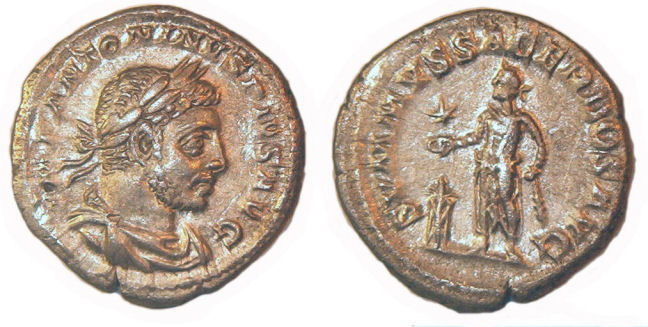
Elagabalus — Denarius (AD 221–222)
Mint: Rome
Obverse:
IMP ANTONINVS PIVS AVG; laureate, horned and draped bust right
Reverse:
SVMMVS SACERDOS AVG; Elagabalus standing left, sacrificing from patera over lit tripod, holding branch; star in left field
Type: Denarius
References:
RIC 146
Historical Note:
The title SVMMVS SACERDOS AVG ("Highest Priest of the Emperor") explicitly emphasizes Elagabalus’s primary identity as the hereditary
high priest of the Syrian sun god, El-Gabal. The horned bust on the obverse and the star on the reverse are distinct nods to this solar cult.
By placing his priestly duties above his imperial ones on this coin, Elagabalus signaled the profound, and often controversial,
shift he attempted to impose on the Roman religious landscape by centralizing the Sun god at the head of the pantheon.
|
Roman Empire
|
|
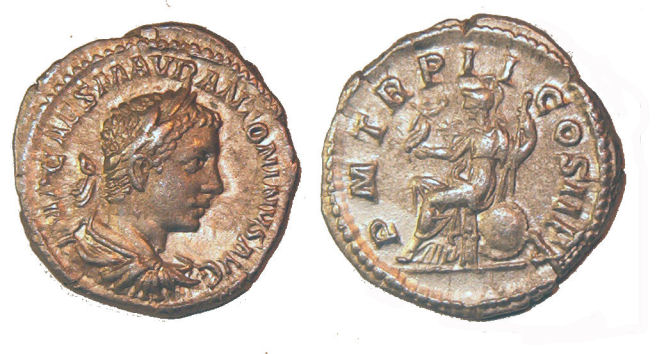
Elagabalus — Denarius (218 CE)
Mint: Rome
Obverse:
IMP CAES M AVR ANTONINVS PIVS AVG; laureate, draped bust right
Reverse:
P M TR P II COS II P P; Roma seated left, holding Victory and spear; shield below
Type: Denarius
References:
RIC (Refer to RIC 12-16 sequence; 171a is likely an incorrect attribution)
Historical Note:
This denarius features the classic Roma seated reverse, a standard choice used by the new Emperor Elagabalus in 218 CE to signal
stability and legitimate authority to the Roman establishment. By utilizing the traditional imagery of the goddess Roma holding Victory,
the administration sought to align the young, unconventional emperor with the long-standing virtues and continuity of the Roman state.
|
Roman Empire
|
|
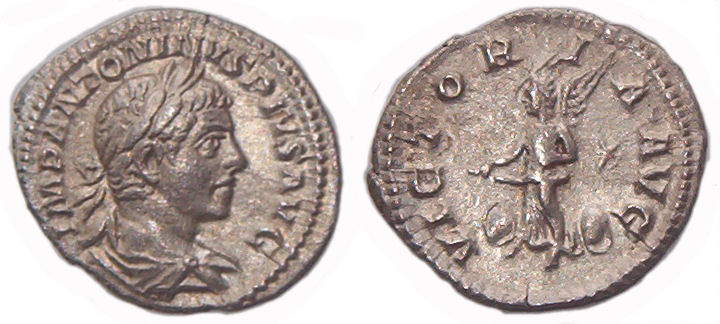
Elagabalus — Denarius (AD 221–222)
Mint: Rome
Obverse:
IMP ANTONINVS PIVS AVG; laureate, draped bust right
Reverse:
VICTORIA AVG; Victory standing left, holding open wreath; shields at feet; star in right field
Type: Denarius
References:
RIC 161
Historical Note:
The VICTORIA AVG reverse was a powerful propaganda tool, asserting the Emperor's military success and divine favor despite the actual
political instability of the time. The inclusion of a star in the field is a notable detail, often associated with the solar motifs prevalent
during Elagabalus's reign. By invoking the goddess Victory, the administration provided the public and the military with a traditional and
reassuring symbol of triumph, bridging the gap between the Emperor's controversial religious reforms and the conventional expectations of imperial power.
|
Roman Empire
|
|




























 Follis B SMK N.90595.jpg)